
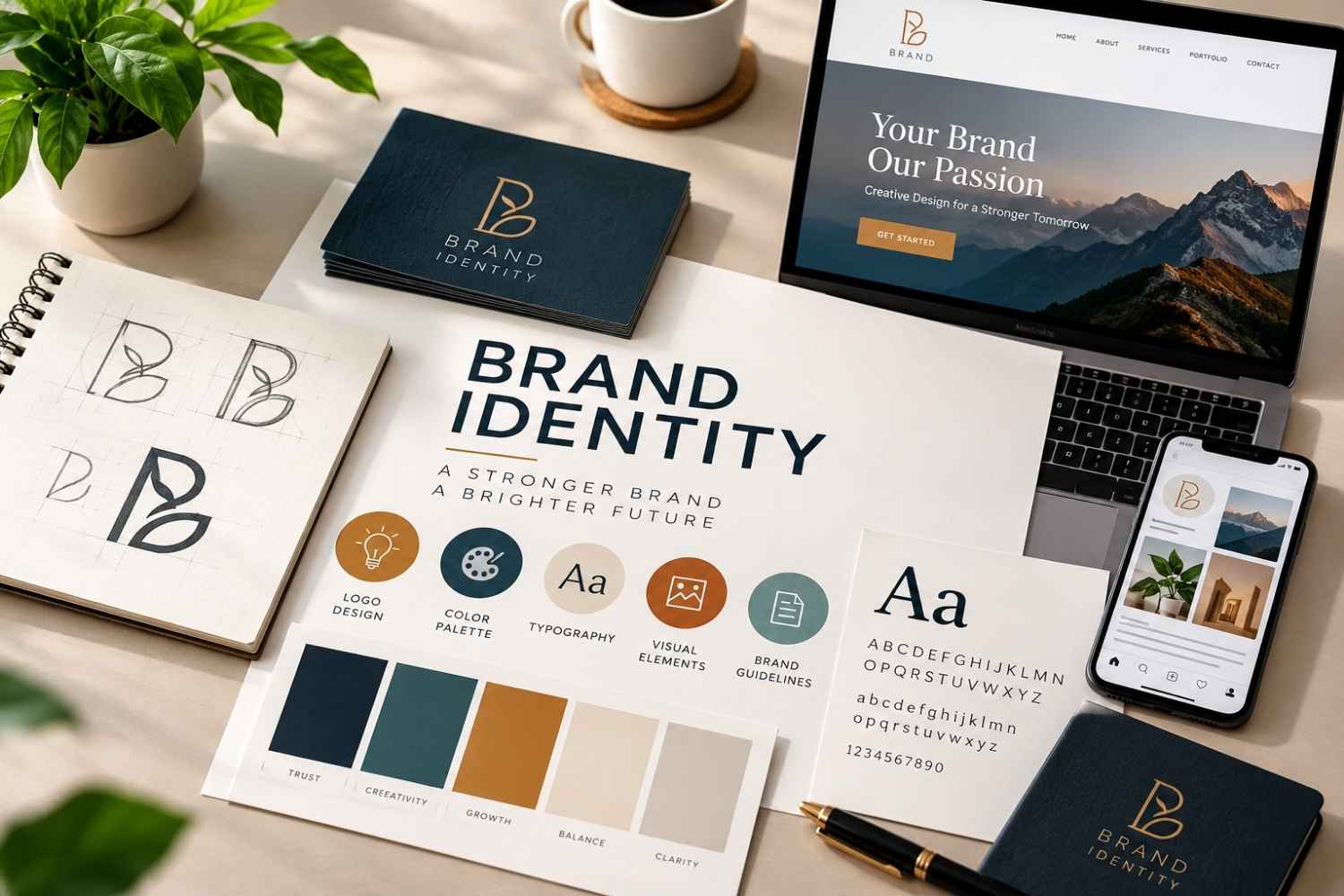
Brand identity is the visual and creative system that helps people recognize a business and understand what it represents. It includes a company’s logo, colors, typography, imagery, graphic elements, and the way these components work together across marketing materials and digital platforms. A strong brand identity helps businesses communicate consistently, stand out in competitive markets, and create a recognizable presence.
For businesses investing in professional design, brand identity is more than an attractive logo. It is a coordinated approach to communicating a company’s personality, values, and purpose. Bella Design, a creative design studio based in Byron Center, Michigan, offers brand identity services focused on distinctive visual communication through thoughtful use of color, typography, and composition.
Quick answer: Every business needs a clear identity because it shapes how customers recognize, remember and trust it. A consistent logo, color palette, typography and visual style help a company look professional, stand apart from competitors and communicate the same message on its website, printed materials, presentations and social media.
Below, you will also find a practical checklist, a look at what Should You Expect From a Branding Project, and answers to common questions, so you can review your own materials and decide where to focus first.
What Does Brand Identity Include?
A brand identity combines several visual elements into one recognizable system. Each element serves a purpose, but the greatest value comes from how they work together.
Logo Design
A logo is often the most recognizable visual element of a business. It may appear on a website, business card, product package, presentation, or social media profile.
An effective logo should reflect the nature of the business and remain recognizable in different sizes and applications. It should also work within a broader identity system rather than carry the entire responsibility of communicating the brand.
For example, a professional services company may need a clean, confident logo that works well on proposals and presentations. A creative business might choose a more expressive visual direction. The right approach depends on the audience, industry, and positioning.
Brand Colors
Color helps establish a visual personality and makes a brand easier to recognize. A carefully selected palette can create a sense of consistency across websites, printed materials, advertising, and other customer touchpoints.
Businesses should select colors based on their positioning, audience, and practical requirements rather than choosing them simply because they are fashionable.
It is also important to check how colors appear on screens and in print. Maintaining suitable contrast and accessibility helps people read content comfortably and interact with digital materials.
Typography
Typography influences how a brand communicates. Font styles, sizes, spacing, and hierarchy can make a business appear formal, approachable, modern, traditional, or creative.
A practical typography system usually defines which fonts to use for headings, body text, and supporting information. This helps marketing materials remain consistent even when different people create them.
Readability should remain a priority. A visually interesting font may suit a logo but may not work well for long paragraphs on a website.
Imagery and Graphic Elements
Photography, illustrations, icons, patterns, and supporting graphics help reinforce a brand’s visual personality.
A company that serves industrial customers, for example, may benefit from imagery that communicates technical knowledge and reliability. A lifestyle business might use photography that emphasizes experiences, products, or the people it serves.
These are general design considerations, not prescribed solutions for every business. The important point is that visual choices should support the brand’s message rather than feel disconnected from it.
Brand Guidelines
Brand guidelines explain how the identity should be used. Depending on the project, they may cover logo variations, color specifications, typography, spacing, imagery, and examples of correct and incorrect usage.
Guidelines are particularly valuable when a business has several departments, marketing partners, locations, or product lines. They give everyone a shared reference for producing consistent communications.
Why Is Brand Identity Important for Business Growth?
A thoughtful brand identity can support marketing and communication by helping a business present itself consistently. It does not guarantee sales or customer loyalty, but it provides a foundation for a more recognizable and coherent brand experience.
It Helps Customers Recognize Your Business
Customers may encounter a business through search results, social media, advertisements, printed materials, or recommendations. Consistent visual elements can help them connect these different interactions to the same company.
When the logo, colors, typography, and imagery follow a recognizable system, the business is less likely to appear different from one channel to another.
Recognition develops over time through repeated, consistent exposure. A new logo alone cannot create that familiarity.
It Communicates Professionalism
Customers often form impressions before speaking directly with a company. A well-organized website, consistent marketing materials, and clear visual communication can help a business present itself professionally.
Inconsistent branding, outdated graphics, and conflicting design styles can make it harder for customers to understand what a company offers.
Professional design should support the actual quality of the business. Visual presentation is one part of building credibility, alongside customer service, product quality, transparent communication, and reliable delivery.
It Helps Differentiate Your Business
Businesses operating in the same industry may offer similar products or services. Brand identity provides an opportunity to express what makes one business distinctive.
The process should begin with understanding the audience, competitors, company values, and intended market position. Designers can then develop visual elements that support those differences.
Simply choosing unusual colors or an elaborate logo is not enough. The identity should reflect a meaningful distinction that customers can understand.
It Creates Consistency Across Marketing Channels
A brand may appear on a website, brochure, business card, presentation, email signature, or social media graphic. Without clear guidelines, these materials can develop different styles over time.
A coordinated identity helps maintain a unified appearance across channels. This makes marketing easier to manage and helps customers recognize the same business wherever they encounter it.
How Do You Develop a Strong Brand Identity?
Creating a brand identity involves research, strategic decisions, design development, and practical implementation. Following a structured process can help businesses avoid making decisions based only on personal preferences.
Step 1: Define Your Brand’s Purpose and Positioning
Start by identifying what your business does, whom it serves, and why customers should consider it.
Ask questions such as:
- What products or services do we provide?
- Who is our ideal customer?
- What problems do we help solve?
- What distinguishes us from competitors?
- What three qualities should customers associate with our business?
The answers establish a direction for the visual identity. For example, a business that wants to communicate technical expertise may need a different visual approach from a brand focused on creativity and personal expression.
Step 2: Understand Your Audience
A successful identity should make sense to the people the business wants to reach.
Research customer expectations, industry conventions, purchasing priorities, and the way competitors present themselves. This helps identify opportunities to communicate more clearly without copying another company’s style.
Audience research can also reveal practical needs. A business selling to corporate clients may rely heavily on proposals and presentations, while a retail business may need packaging and product imagery to play a larger role.
Step 3: Establish a Visual Direction
Once the strategic foundation is clear, explore possible combinations of color, typography, logo concepts, imagery, and graphic elements.
The goal is to find a visual direction that reflects the business and works across its intended applications.
Comparing concepts against the original brand objectives can make feedback more productive. Instead of asking only which design looks best, consider which one communicates the intended message most effectively.
Step 4: Create a Flexible Identity System
A brand needs to work in more than one situation. The logo should be usable across relevant formats, and the supporting design elements should work together in digital and print environments.
Consider how the identity will appear on:
- Desktop and mobile websites
- Business cards and brochures
- Digital advertisements and social media
- Reports and presentations
- Packaging or signage, where relevant
Testing these applications early helps identify problems before the identity is rolled out widely.
Step 5: Document the Brand Standards
Prepare practical guidelines that explain how to use the identity. Include the appropriate logo files, color values, font choices, and examples of common applications.
The documentation should be detailed enough to support consistency without making everyday marketing unnecessarily difficult.
If multiple teams or external suppliers will use the identity, provide accessible files and clear instructions. A good design system is useful only when people can apply it correctly.
Step 6: Apply the Identity Consistently
The final step is implementation. Update the website, marketing materials, presentations, social profiles, and other relevant customer touchpoints.
Review the results periodically to make sure the identity remains appropriate as the business develops. Consistency does not mean that every design must look identical; it means that each application should still feel like part of the same brand.
What Is the Difference Between Brand Identity and Brand Image?
Brand identity and brand image are related, but they are not the same.
Brand identity is how a business deliberately presents itself. It includes the visual system, messaging, and other elements the company develops to express its personality and positioning.
Brand image is how customers actually perceive the business. It is shaped by their experiences, expectations, interactions, and opinions.
A company can create a polished visual identity, but its brand image also depends on whether its products, services, and customer experiences meet expectations.
For example, a business may use design elements intended to communicate reliability. Customers will form their own judgments based on whether the company responds promptly, delivers as promised, and resolves problems effectively.
The strongest brands align what they communicate with what they consistently deliver.
How Can Professional Design Support Brand Identity?
Developing an identity requires more than selecting a logo and a color palette. Businesses must consider how individual design decisions work together and how the finished identity will be used over time.
A design professional can help organize these decisions into a coherent visual system. This may involve exploring concepts, refining typography, selecting colors, preparing logo variations, and developing guidance for marketing applications.
Bella Design lists brand identity among its core services, alongside marketing collateral, annual reports, and website development. These related services can be useful when a business wants its visual identity to carry through into printed materials, reports, and its online presence.
Bella Design also publishes a client testimonial describing its work on Andronaco Industries’ corporate logo and branding guidelines. According to that testimonial, the guidelines helped establish a consistent visual framework for marketing materials, presentations, and digital communications. This illustrates a practical purpose of brand guidelines: helping a business maintain a coordinated identity across different types of communication.
Businesses considering a branding project can review the Bella Design services page and portfolio to learn more about the studio’s work.
What Are the Common Brand Identity Mistakes to Avoid?
Even a well-intentioned branding project can become less effective when important practical considerations are overlooked.
Designing Without a Clear Strategy
Choosing colors and logo styles before defining the audience and positioning can lead to an identity that looks attractive but communicates little about the business.
Establishing objectives first gives the design process a clearer purpose.
Following Every Design Trend
Trends can provide inspiration, but an identity should remain appropriate as the business evolves. Design choices should reflect the company’s positioning rather than depend entirely on what is popular at the moment.
Using Inconsistent Visual Elements
Different logos, conflicting colors, and unrelated typography across marketing channels can weaken recognition. Documented brand standards help reduce these inconsistencies.
Ignoring Digital and Print Requirements
A logo that looks good on a large screen may become difficult to read at a smaller size or reproduce poorly in print. Testing the identity across its intended applications helps reveal these issues.
Treating Branding as a One-Time Logo Project
A logo is an important asset, but it is only one part of a brand identity. Businesses also need consistent supporting elements, useful guidelines, and a plan for applying the identity across customer touchpoints.
When Should a Business Consider a Brand Identity Refresh?
A brand refresh may be worth considering when the existing identity no longer reflects the business or creates practical problems.
Possible signs include:
- The business has expanded into new markets or services.
- Its current visual identity feels disconnected from its positioning.
- Different teams use inconsistent logos, colors, or typography.
- The company has undergone a significant change in direction.
- Existing branding does not work effectively across current digital and print channels.
A refresh does not always require a complete redesign. Sometimes, clearer guidelines, improved typography, updated supporting graphics, or more consistent implementation can address the problem.
Before making changes, assess what customers already recognize and which parts of the identity still work. Preserving valuable recognition while addressing genuine weaknesses can provide a more considered approach than changing everything without a clear reason.
Build a Brand Identity That Communicates Clearly
Brand identity gives a business a visual foundation for presenting its purpose, personality, and value. When logo design, color, typography, imagery, and brand guidelines work together, they help create a consistent experience across marketing channels.
The most effective identity begins with a clear understanding of the business and its audience. It should be distinctive without sacrificing usability, flexible enough for different applications, and supported by the quality of the company’s actual products and services.
If your business needs a new identity or wants to bring greater consistency to its existing branding, explore the services and work featured on Bella Design. You can also contact Bella Design to discuss your goals, design needs, and potential branding project.
Brand Identity Checklist: Is Your Business Ready to Grow?
Before expanding into new services, markets or marketing channels, it is worth checking whether your current identity can support that growth. Ask yourself:
- Do you have high-quality logo files for print, web and social media?
- Are your brand colors defined with exact values for screen and print?
- Do employees and partners know which fonts to use?
- Do your website, brochures and presentations look like they come from the same company?
- Is there a simple guide that explains how to use your brand?
- Does your visual style still reflect the services and audience you serve today?
Gaps in this list are common, and most can be closed one asset at a time, beginning with clean logo files and defined color values that every vendor can use. Once those basics exist, a short usage guide can follow, and it becomes far easier to brief a printer, sign maker or web developer without repeating instructions each time.
If several answers are no, a focused identity project or brand refresh may help before investing in new marketing materials.
What Should You Expect From a Branding Project?
Every studio works differently, but most branding projects follow a similar path from discovery to delivery:
- A conversation about your business, audience, goals and competitors
- Research and early visual exploration
- Design concepts for the logo and supporting elements
- Refinement based on your feedback
- Final files prepared for print and digital use
- Basic usage guidance so the identity is applied consistently
Knowing these stages ahead of time makes it easier to plan feedback, gather materials and set realistic expectations for your team.
Frequently Asked Questions
What is brand identity in simple terms?
Brand identity is the collection of visual and creative elements a business uses to present itself. These can include its logo, colors, typography, imagery, and brand guidelines.
Why is brand identity important for a small business?
It helps a small business present itself consistently, communicate its personality, and build recognition across websites, marketing materials, and other customer interactions.
What are the main elements of brand identity?
The main elements generally include a logo, color palette, typography, imagery, supporting graphics, and guidelines for consistent use.
How often should a business update its brand identity?
There is no universal schedule. A business should review its identity when its positioning changes, its visual system becomes inconsistent, or its current branding no longer meets its needs.
Can a professional designer help create brand guidelines?
Yes. A designer can help define logo usage, colors, typography, and supporting visual elements so employees and marketing partners can apply the identity consistently.
Is a logo the same as a brand identity?
No. A logo is one part of an identity. A complete identity also includes colors, typography, imagery and the rules that tie these elements together.
Can a small business benefit from a professional identity?
Yes. A clear, consistent identity can help a small business look established and make its marketing easier to recognize.
What files should I receive at the end of a branding project?
Typically, you should receive logo files in formats suited to print and digital use, along with your color values, font names and basic usage guidance.
How do I keep my identity consistent across vendors?
Share a simple brand guide and approved files with every printer, web developer and designer you work with, and keep one person responsible for brand approvals.
How often should a business review its identity?
Review it when your services, audience or goals change, or when your materials start to look inconsistent across channels.
Does a refresh mean losing brand recognition?
Not necessarily. A refresh can modernize the look while keeping familiar elements, such as core colors or the basic logo shape, so customers still recognize you.
If your logo, colors and fonts no longer tell one clear story, Bella Design can help bring them together. Our Byron Center, Michigan studio creates identities for organizations across West Michigan and beyond. Review our branding services, reach out online or call (616) 450-6873.