
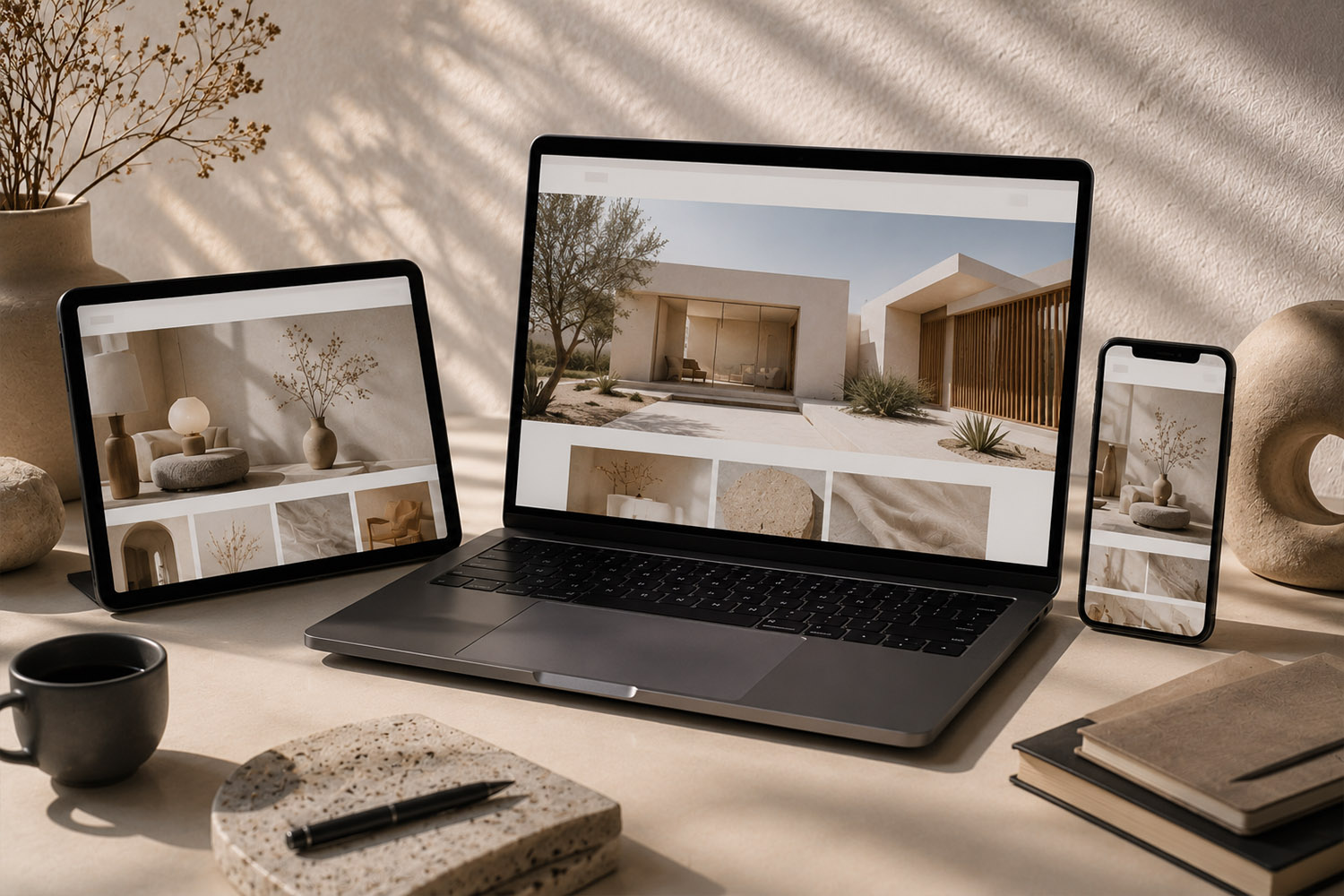
A website is often one of the first meaningful interactions someone has with a business. Before making contact, requesting a quote, booking a service, or making a purchase, potential customers will often visit your site to understand who you are and decide whether your business feels right for them.
That makes your site much more than a collection of pages.
It is your digital presence, a communication platform, and an important extension of your brand.
At Bella Design, we approach website design and development by bringing together visual identity, thoughtful structure, functionality, and user experience. The goal is to create websites that not only look distinctive but also help visitors understand, explore, and connect with your business.
Quick answer: A website turns an online presence into a meaningful experience when it combines clear design, useful content and easy navigation that reflect the brand. Visitors should quickly understand who the business is, find what they need on any device and know exactly how to take the next step.
Below, you will also find a practical checklist, a look at small Website Updates That Make a Big Difference, and answers to common questions, so you can review your own materials and decide where to focus first.
Your Digital Presence: First Impressions Happen Quickly
People form opinions about websites almost immediately.
Typography, imagery, color, spacing, navigation, and overall presentation can influence whether a visitor continues exploring or leaves.
A professional website creates confidence.
It shows that attention has been given to how the business presents itself and how customers experience it. Every visual detail contributes to that impression, from the scale of a heading to the way images are positioned.
Good website design should therefore feel intentional from the moment someone arrives.
Website Design Should Reflect Your Brand
Your site should feel unmistakably connected to your brand.
A luxury beauty business may need an elegant and refined digital experience, while a creative studio might benefit from expressive layouts and stronger visual movement. A professional organization may require a structured, information-focused approach.
There is no single design style that works for every business.
Instead, the visual direction should be developed around the personality, positioning, audience, and objectives of the individual brand.
Colors, typography, imagery, layouts, buttons, icons, and interactive elements should work together to create one consistent digital language.
When visitors move from your social media or promotional materials to your site, the experience should feel connected.
User Experience Comes First
A beautiful website becomes less effective when visitors cannot easily find what they need.
User experience is therefore an essential part of good website design.
Navigation should be intuitive. Important information should be easy to locate. Content should follow a logical structure, and calls to action should guide visitors toward the next step.
The journey might involve exploring services, viewing previous work, reading a blog, completing a contact form, or making an enquiry.
Whatever the goal, the site should make that journey simple.
Thoughtful user experience reduces unnecessary friction and allows design to support the visitor rather than distract them.
Responsive Design Is Essential
People no longer experience websites on one standard screen.
A visitor might discover your business on a smartphone, continue browsing on a tablet, and return later using a desktop computer.
Your site needs to work effectively across all of them.
Responsive design allows layouts, typography, images, navigation, and content to adapt to different screen sizes.
But responsive design is more than simply shrinking a desktop page.
Mobile experiences require careful consideration of spacing, touch interactions, content order, image proportions, navigation, and readability.
Each screen should feel intentionally designed rather than treated as an afterthought.
Content and Design Work Together
Even the strongest visual design needs good content.
Headings help visitors understand what a page is about. Service descriptions explain what you offer. Project information demonstrates your experience. Calls to action encourage engagement.
Design determines how that information is presented.
Clear hierarchy helps visitors identify important content quickly, while thoughtful spacing prevents pages from feeling overwhelming.
Photography, graphics, and visual elements can support written content by adding personality and context.
When content and design are developed with the same objective, the site becomes easier to understand and more persuasive.
Digital Presence Performance Matters
Visual quality is important, but a website also needs to perform well.
Large images, unnecessary scripts, excessive animations, and poorly optimized elements can slow down a website and create frustration.
Performance should therefore be considered throughout the design and development process.
Images can be optimized without sacrificing visual quality. Animations can be used purposefully rather than excessively. Pages can be structured efficiently to support faster loading and smoother interaction.
A website that feels quick and responsive creates a better experience for visitors and provides a stronger technical foundation for search visibility.
Designing Your Digital Presence With Search in Mind
A beautiful website has limited value if potential customers cannot discover it.
Search visibility should be considered when planning the structure and content of a website.
Clear page hierarchy, meaningful headings, useful content, descriptive page information, internal links, mobile responsiveness, and technical performance all contribute to a stronger search-friendly foundation.
Modern discovery also extends beyond traditional search engines.
Answer engines and AI-powered platforms increasingly influence how people research businesses, services, and information.
Creating well-structured, useful, understandable content can help prepare a website for this evolving search environment.
Design, development, SEO, AEO, and GEO work best when considered as connected parts of the overall digital experience.
Calls to Action Guide Your Digital Presence
Every website should have a purpose.
For one business, that may be generating enquiries. For another, it could be encouraging bookings, showcasing a portfolio, selling products, or building credibility.
Calls to action help connect the site experience with these business goals.
Buttons such as Get in Touch, View Our Work, Explore Services, or Start a Project give visitors clear direction.
Their placement matters.
A call to action should appear naturally when a visitor has enough information to make a decision rather than feeling forced into every section.
Thoughtful design creates a journey where the next step feels obvious.
Small Details Create Better Experiences
Some of the most effective aspects of website design are the details users may not consciously notice.
Consistent spacing creates rhythm. Subtle transitions make interactions feel smoother. Clear hover states show that elements are clickable. Carefully selected typography improves readability.
Even simple details such as button sizes, form fields, image cropping, and menu behavior can influence the overall experience.
These elements may appear small individually, but together they determine whether a website feels polished and considered.
Attention to detail is what often separates a standard website from a distinctive digital experience.
A Website Should Be Built to Grow
Businesses evolve.
New services are introduced, portfolios expand, teams change, content grows, and marketing strategies develop.
A website should be able to evolve alongside the business.
Creating a clear design system and flexible page structure makes future updates easier while maintaining visual consistency.
Instead of treating the site as something that is completed once and forgotten, it can become an adaptable platform that continues supporting the brand.
Planning for growth from the beginning creates a stronger long-term digital foundation.
Digital Presence Review: 6 Questions to Ask
A quick review can show whether your website is giving visitors a good experience:
- Does the homepage explain what you do in a sentence or two?
- Is the design consistent with your logo, colors and printed materials?
- Can visitors reach your contact details from every page?
- Do pages load and display well on a phone?
- Is the content current and free of outdated details?
- Does each page end with a clear next step?
Keep a note of your answers; repeating the same six questions after each update makes progress easy to see. Comparing your notes from one review to the next shows which changes actually improved the experience and which areas still need attention before visitors notice them.
Answering these questions honestly is a simple way to find the improvements that matter most.
Small Website Updates That Make a Big Difference
Not every improvement requires a full redesign. Helpful updates can include:
- Refreshing photos so they reflect your current work
- Simplifying menus so key pages are easy to find
- Adding short answers to common customer questions
- Updating calls to action so they are clear and specific
- Compressing large images so pages load faster
Over time, small, steady updates can keep a website useful and aligned with the brand.
Creating Websites With Purpose
A successful website brings together many different disciplines.
Brand identity creates personality. User experience creates clarity. Development provides functionality. Responsive design ensures accessibility across devices. Performance keeps interactions smooth, while search optimization helps people discover the business.
When these elements work together, the website becomes more than an online brochure.
At Bella Design, we create websites around the individual character and goals of each brand. From visual direction and responsive layouts to thoughtful development and user-focused experiences, every element is considered as part of one connected digital presence.
Whether you’re creating a new website or refreshing an existing one, thoughtful design can transform how people experience your business online.
Because a successful website shouldn’t simply look good.
It should communicate clearly, feel effortless to use, represent your brand with confidence, and encourage visitors to take the next step.
Ready to create a website that feels as distinctive as your brand? Let’s build a digital experience designed to connect, engage, and grow.
Frequently Asked Questions
How often should I update my website?
Review your site regularly and update it whenever services, contact details or branding change.
Is a redesign always necessary?
No. Many sites can be improved with content, image and navigation updates before a full redesign is needed.
Why does mobile design matter?
Many visitors browse on phones, so pages should be easy to read and use on smaller screens.
What makes a website feel connected to a brand?
Using the same logo, colors, fonts, imagery and tone of voice as your other marketing materials.
What should a homepage include?
A clear statement of what you do, who you help, the main services and an easy way to get in touch.
How do calls to action help a website?
They guide visitors toward the next step, such as calling, sending a message or exploring a service page.
How can I tell if visitors find my site confusing?
Signs include frequent questions about information that is already on the site, or visitors leaving key pages quickly. Simplifying navigation and wording often helps.
Your website is often the first place people meet your business. Bella Design builds brand-aligned sites from Byron Center, Michigan, for companies in West Michigan and beyond. Look through our web design services, contact us or call (616) 450-6873 to talk it through.